A young boy doing a cartwheel in a grassy field under a cloudy sky

Myopia Management in Burlington

Myopia, also called nearsightedness or shortsightedness, is the inability to see things clearly unless they’re situated close to your eyes. It is the most common refractive error among children and young adults. Most patients with this condition wear eyeglasses or contacts to correct their vision.

However, myopia is more than an inconvenience; it can pose a serious risk to your child’s long-term vision. As a child develops and the myopia rapidly progresses, the child is at a higher risk of developing dangerous eye diseases later in life. Namely, retinal detachment, macular degeneration, glaucoma and cataracts. Thankfully, Myopia Management can help.

Myopia Management solutions include eye drops, specific contact lenses, and glasses, which can help slow down the rapid visual deterioration that occurs with myopia. Contact Dr.'s Eyecare Center Myopia Control Center and see how Myopia Management can help your child experience clearer, sharper vision and a higher quality of life.

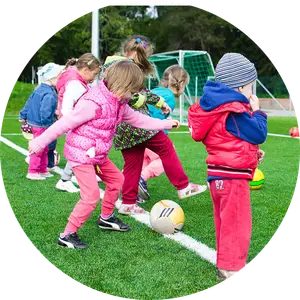
A group of children are playing with soccer balls on a grassy field.

What is Myopia?

Myopia develops when the eye grows too long from front to back, which causes light to focus in front of the retina rather than directly on it. For those with nearsightedness, distant objects appear blurred while nearby objects remain clear.

This condition develops during childhood, when the eyeballs are experiencing rapid growth, and tends to progress gradually or rapidly into the late teen years. Myopia can be easily corrected using corrective glasses or contact lenses.

Childhood myopia is typically diagnosed between the ages of 5 and 7 and worsens during the eye’s rapid growth years. The prescription tends to plateau at around age 12.

The Growing Prevalence of Myopia

Myopia is becoming increasingly prevalent around the world, with a recent study showing that close to 30% of the world’s population is currently myopic. Alarmingly, by 2050, close to 50% of the global population will be myopic. That’s a staggering 5 billion people!

Myopia rates have shot up in the last 20 years. In China, between 10-20 % of primary school children are myopic. This number increases to 50% for high school students, and by the time they reach university, 90% of the student body is nearsighted.

The good news is that thanks to Myopia Management, you can protect your children from landing on the wrong side of this statistic.

An image of a girl wearing glasses and smiling while giving a thumbs up in front of a text that reads, 'Is My Child at Risk? Take the Myopia Test.'

What is Myopia Management?

“Myopia management” is a series of treatments that eye doctors use to slow the progression of myopia in children. Our myopia management treatments can induce changes in the structure of the eye by diminishing the stress and fatigue linked to the development and progression of myopia. Several studies have indicated that these treatments successfully slow down the progression of nearsightedness in children and teens.

The Dr.'s Eyecare Center Myopia Control Center currently offers several different customized treatment options to slow the progression of myopia. Our doctors work closely with each family and customize treatment programs for every child based on their unique needs.

Patients are carefully monitored by our doctors and reviewed every 6-12 months to assess the efficacy of the chosen treatment modality.

Dr.'s Eyecare Center Myopia Control Center is a Myopia Management practice that offers evidence-based treatment to prevent the onset or reduce the progression of myopia in pediatric patients.

Because we stay on the forefront of the latest research, you can be sure that Dr.'s Eyecare Center Myopia Control Center is maximizing the chances of your child’s success.

Patients We Typically Work With

  • Patients with progressive myopia (-0.25DS or more in the last 2 years)
  • Patients with refractive error: MSE (sph + 0.5*cyl): +0.50 DS to -6.00 DS, no limit on DC
  • Patients at risk of becoming myopic due to a family history of myopia (one or two myopic parents)
  • Patients who spend over 3 hours a day doing near work (reading, studying, writing)
  • Patients who spend less than 6 hours a week outdoors
  • Patients under the age of 16
A close-up of a white leaf pattern on a white background, with a slightly blurry effect and small, slightly darker spots. The image has a grainy texture.

What Should the Patient Expect?

To monitor and assess the efficacy of the treatment, all our young patients undergo an extensive vision evaluation, provided by our doctors. This includes:

  • Axial length and retinal shape measurements
  • Cycloplegic axial and peripheral autorefraction
  • Corneal topography and choroidal thickness measurements
  • Lifestyle questionnaire (including how much near work and outdoor activity they engage in per day/week)
  • Discussion of the results
  • Development of a personalized treatment plan

At Dr.'s Eyecare Center Myopia Control Center, we provide our patients with effective, customized treatment to control the progression of myopia. By stopping or slowing down the progression of myopia, we reduce long-term risks to best ensure that your child enjoys the world with healthy eyes throughout his or her life.

Dr.'s Eyecare Center Myopia Control Center serves patients in Burlington, Cherry Hill, Trenton, Hamilton Township, and throughout New Jersey.

Serving Myopia Management Patients From:

Burlington | Cherry Hill | Trenton | Hamilton Township | and throughout New Jersey

Learn More About Myopia Management

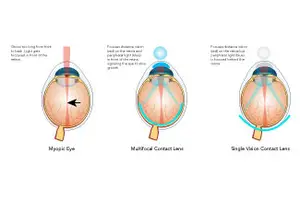
A diagram showing a myopic eye, a multifocal contact lens, and a single vision contact lens.
Specially applied use of soft multifocal contacts for myopia are a popular and effective technique for myopia management, backed by extensive research and prescribed across the globe by optometrists for children as young as 8.
Question mark with lights on a black background
Prolonged computer use can lead to dry eye syndrome for 3 reasons: blue light exposure, infrequent blinking and incomplete blinking. Read on to learn more and discover how a dry eye optometrist can help.
A woman with blonde hair is smiling while holding a smiley face balloon with her right hand
Ortho-k contact lenses are among the finest contact lenses on the market, made with superior quality materials and completely personalized to each eye for an exclusively customized visual experience. Their cost, while higher than standard lenses, are worth it in the long run. Here's why.
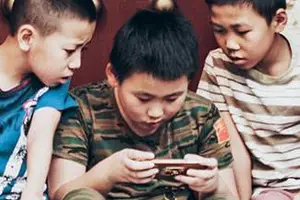
Three young boys are sitting on a couch and looking at their phones. They are all wearing casual clothing, and the boy in the middle has a camouflage shirt with a flag on it. The boy on the left is wearing a blue shirt with a pink design, while the boy on the right is wearing a white shirt with stripes. They are probably looking at a video or a photo on their phones.
The overuse of digital media in today’s day and age is not without concern, especially for children. While these devices have improved our lives in many ways, certain physical and mental problems can result from overexposure to screens. By following the following measures and tips, you’ll keep your tech-savvy child seeing clearly and feeling healthy.
portrait of a man wearing glasses and a blue shirt
Vision Correction is used to correct refractive errors such as myopia (nearsightedness), hyperopia (farsightedness), astigmatism (when light enters the eye incorrectly), or presbyopia (farsightedness due to aging). Read on to learn all about surgery-free vision correction.
Two young children sitting on grass wearing hats, one holding a phone
Myopia progression in children dramatically increases the risk of developing serious eye conditions later in life, such as cataracts, retinal detachments, macular degeneration, and glaucoma.
A book with its pages folded into the shape of a heart
The prevalence of myopia in the world is growing at high rates. Scientists are researching the reasons and treatment methods all over the world. Find here a list of recent relevant studies concerning myopia management.
Three young children are lying down on a bed, smiling and posing for a photograph.
If your child has myopia, take action and help mitigate their risk of developing eye disease in the future. Read on to learn about myopia management, and whether your child could be a candidate.
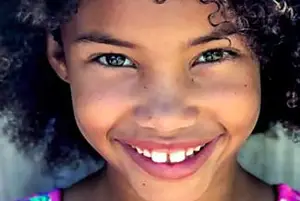
A young girl with curly hair and a bright smile is captured in a close-up shot, showcasing her vibrant green eyes and dimples on her cheeks. She is wearing a pink top with a white collar and has a mole on her left cheek. Her hair is messy and curly, and she is likely in a studio or a room with a light source behind her.
By slowing myopia progression early on, you can significantly reduce your child's risk of developing sight-robbing eye diseases later in life. Read on to learn about the various myopia management treatments in use, and their associated benefits.
A person sitting at a desk writing on a piece of paper with a pen
Take the Myopia Questionnaire to assess the symptoms of your eyes that could be hindering the quality of your vision.

Read Our Latest Posts

A woman in glasses is sitting at a desk in an office, working on her laptop, with a plant and a glass of water nearby, and a cityscape visible through the window.

Don’t Miss Out on Your 2025 Vision Insurance Benefits »

residents have until December 31 to use their 2025 vision insurance benefits. makes it easy to schedule a family eye exam, shop designer frames, or get fitted for contact lenses...
Read More